If someone else’s carelessness left you hurt, you may be owed money for your medical bills, your lost pay and everything this has cost you since. Answer a few questions and a claim specialist will call you back — then match you with a personal injury attorney who handles your type of claim in your state. The case review is free and there is no fee unless you win.

Free and confidential. Submitting this does not create an attorney-client relationship.
A claim specialist will review your answers and call the number you gave us, then introduce you to a personal injury lawyer licensed in your state. If you would rather not wait, you can reach us right now.
Call 800-589-3204This is an advertisement · Injury Case Claim is not a law firm
Personal injury is the area of law that covers harm to your body or mind caused by someone else’s carelessness or deliberate act, rather than damage to your property. If a driver, an employer, a property owner, a doctor or a manufacturer failed to take reasonable care and you got hurt as a result, that is a personal injury claim.
A personal injury lawyer — also called an injury attorney or accident and injury lawyer — builds that claim and argues it against whoever’s insurer has to pay. In practice that means gathering your medical records, proving who was responsible, calculating what the injury will cost you over your lifetime rather than just this month, negotiating with an adjuster whose job is to pay you as little as possible, and filing suit if the offer stays too low.
They are paid on contingency, which means a percentage of what they recover and nothing at all if they recover nothing. That is why almost every personal injury law firm offers a free consultation: it costs you nothing to find out whether you have a case.
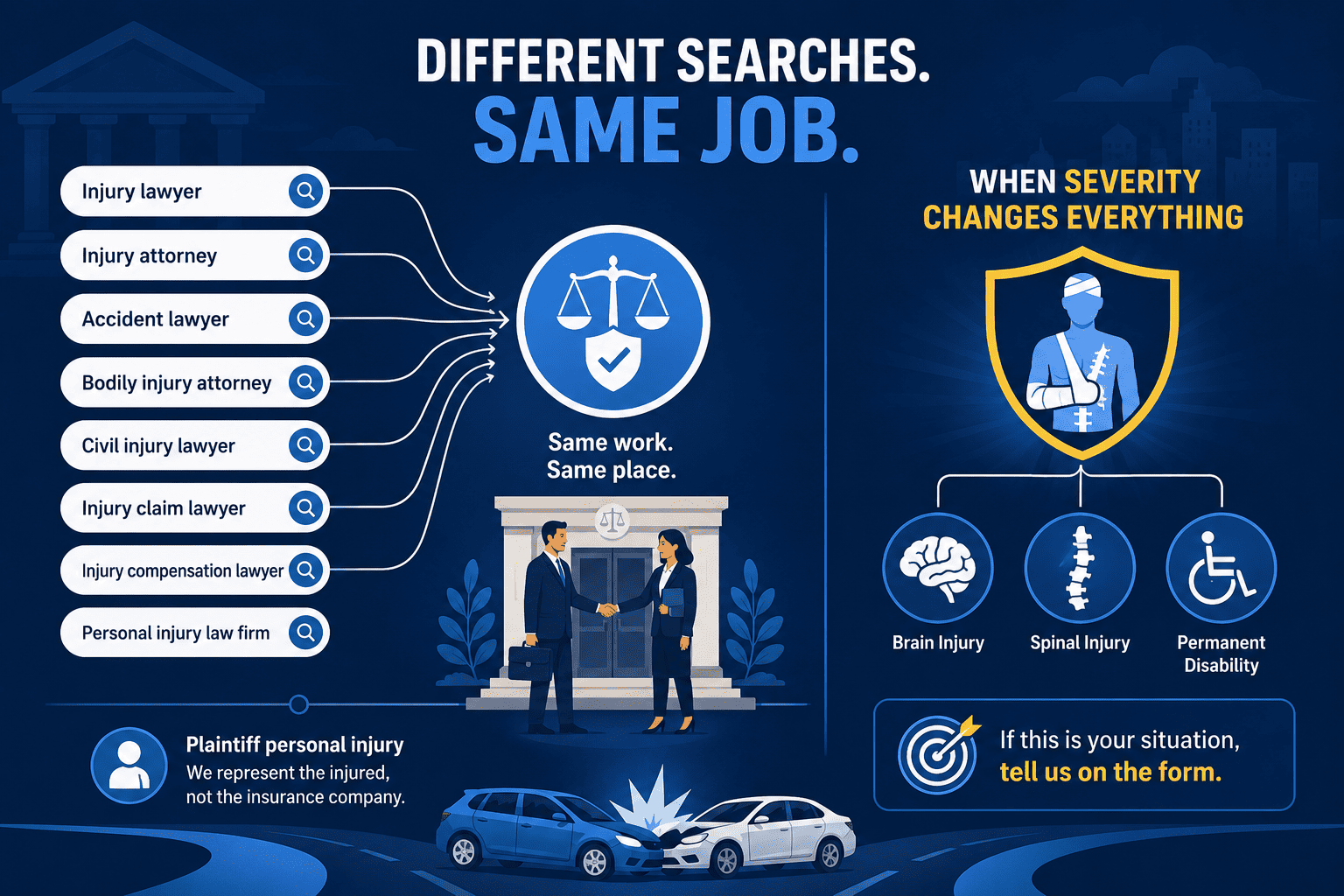
People search for this in a dozen different ways and they all land in the same place. Injury lawyer, injury attorney, accident and injury lawyer, bodily injury attorney, civil injury lawyer, injury claim lawyer, injury compensation lawyer and personal injury law firm all describe the same work. Some firms say plaintiff personal injury, because they act for the injured person rather than the insurer.
Where the words genuinely matter is severity. A catastrophic injury attorney or serious injury lawyer handles claims involving permanent disability, brain and spinal injury or disfigurement, where lifetime care costs run into millions and the case almost always has to be built for trial. If that describes your situation, say so on the form.
Personal injury covers far more than car crashes. These are the most common types of personal injury claims our network takes on — if what happened to you is not on the list, it is still worth a call, because the same rules apply to almost any injury caused by someone else’s negligence.
Car, truck, motorcycle, pedestrian, cyclist and rideshare crashes caused by another driver’s negligence.
See If You Qualify 02Injured on the job. Beyond workers’ comp, a third party may also be liable — which is where a work injury lawyer matters most.
See If You Qualify 03Unsafe floors, stairs, lighting or security on someone else’s property, including dog bites and negligent security claims.
See If You Qualify 04Surgical errors, misdiagnosis, birth injuries, medication mistakes and nursing home neglect.
See If You Qualify 05Products that failed, caught fire or were sold without a proper warning, plus dangerous drugs and medical devices.
See If You Qualify 06Brain and spinal injury, amputation, severe burns, and claims brought by a family after a death.
See If You QualifyNot sure which one is yours? Plenty of claims sit in more than one category — a burn at work caused by a faulty machine is a workplace injury and a product claim. Pick whichever is closest and the specialist will sort it out on the call.
Start my free reviewBroadly, you have a claim worth taking to an injury attorney if all or most of these are true.
A driver, an employer, a shop, a landlord, a doctor, a manufacturer. The legal test is whether a reasonable person in their position would have acted differently — not whether they meant any harm.
A near miss is not a claim, however frightening. Injuries that surfaced days later still count, and so does psychological harm in most states.
This is the part insurers attack hardest, especially where you had a prior condition. A pre-existing injury that was made worse is still recoverable.
Medical bills, missed shifts, treatment you still need, things you can no longer do.
In some states that is as little as one year, and claims against a government body can require notice within months. Check your deadline →
Two kinds of loss, and people routinely forget the second.
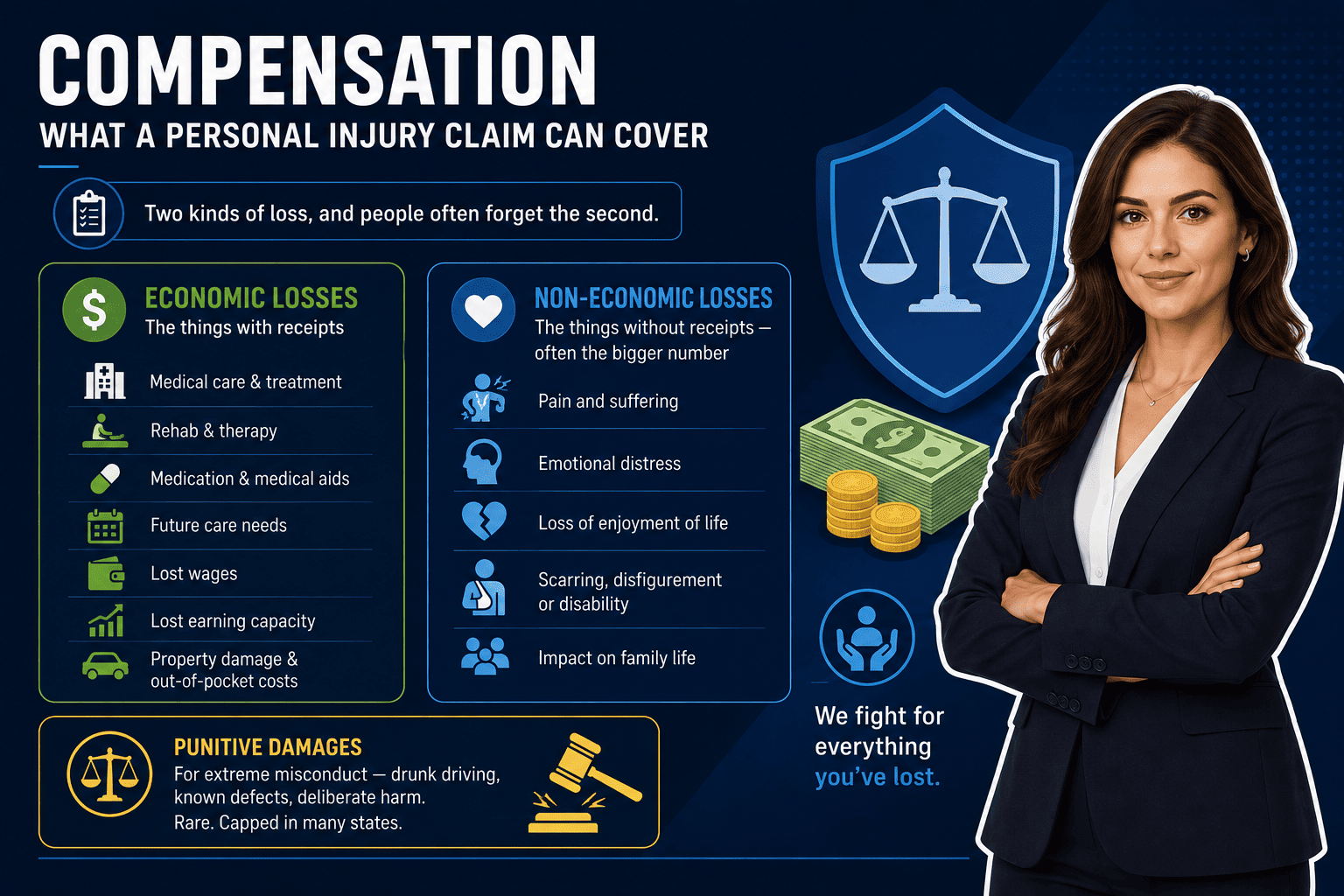
Punitive damages. Where the conduct was extreme — drunk driving, a known defect sold anyway, deliberate harm — some states allow damages meant to punish rather than compensate. They are rare and capped in many places.
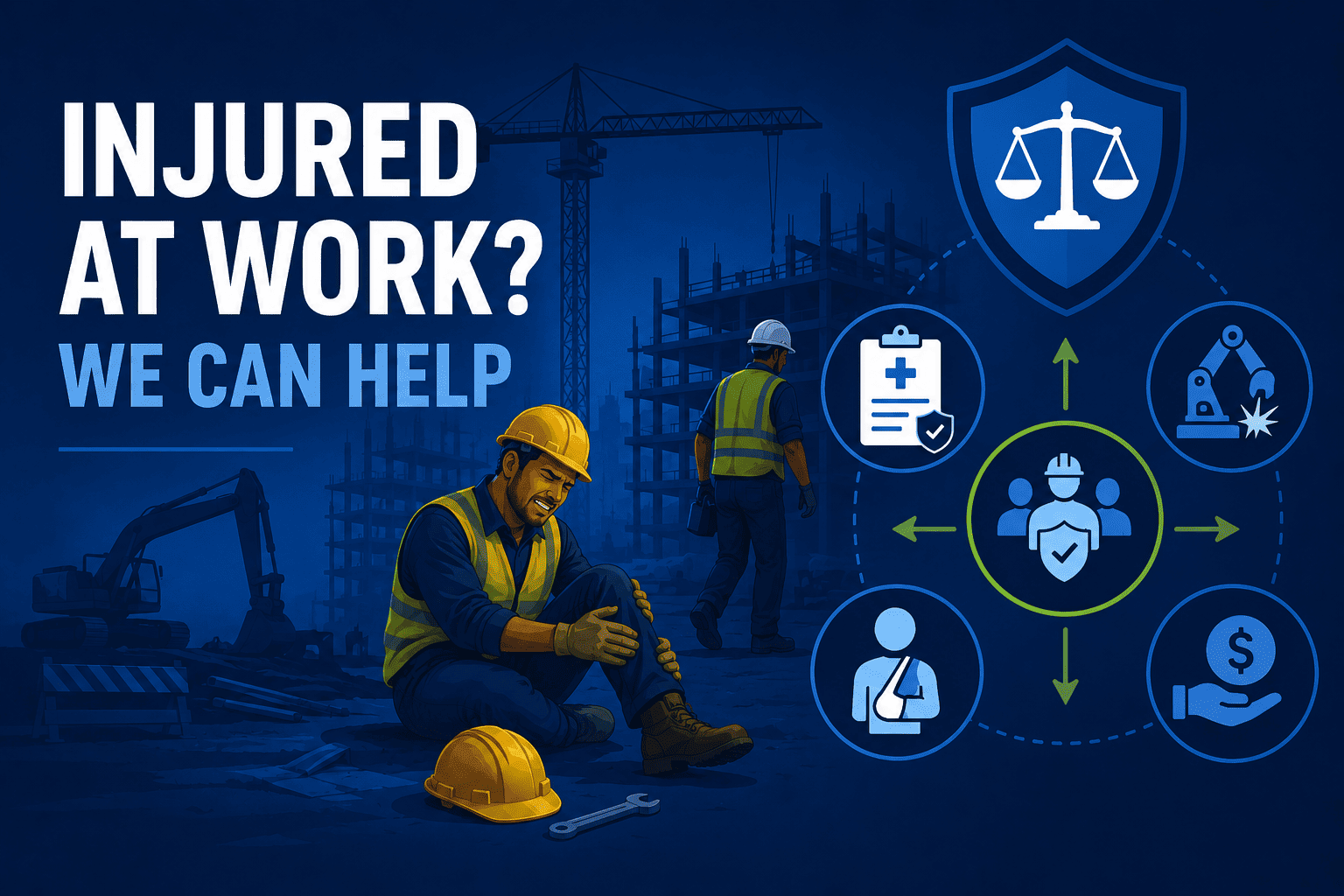
If you were hurt on the job, workers’ compensation should cover your medical treatment and part of your lost wages, no matter who was at fault. What it will not pay you is anything for pain, suffering or the life you had before — and it is capped.
This is the gap a work injury attorney looks for. If someone other than your employer contributed to what happened — a subcontractor on the same site, a delivery driver, the maker of the machine that failed, the owner of the property — you may have a third-party claim alongside your comp claim. That claim is a full personal injury case, with full damages, and it is where the real money in workplace injury usually sits.
A workplace injury lawyer can also step in when comp itself goes wrong: benefits terminated early, treatment refused, a permanent disability rating that does not match your medical records.
If it happened recently, in this order. Step five is the point at which most people start looking for a personal injury attorney.
Adrenaline hides injuries for a day or two. A gap between the incident and your first medical visit is the single most common thing insurers use to argue you weren’t really hurt.
To the police, your employer, the store manager, the property owner — whoever is relevant. Ask for a copy or a reference number. A verbal report that nobody wrote down is very hard to prove later.
The hazard, the scene, the equipment, your injuries as they develop. Spilled liquid gets mopped, broken handrails get fixed, and bruises fade — usually within days.
People leave within minutes and are almost impossible to trace afterwards. A phone number scribbled at the scene has won more cases than most people would guess.
You are allowed to say you will respond after speaking with a lawyer. A first offer arriving inside a week is a sign the adjuster thinks the claim is worth more than they are offering.
Bills, discharge notes, prescriptions, mileage to appointments, and a note of days missed and what you couldn’t do at home. Contemporaneous notes are evidence; memory eighteen months later is not.

Three rules decide what a claim is actually worth, and all three are set state by state. This is why the attorney has to be licensed where it happened.
Most states cut your recovery by your percentage of blame. Some bar recovery entirely once you pass a set threshold. A small number still apply the old contributory-negligence rule, where any fault at all can end the claim.
The statute of limitations for personal injury commonly runs two or three years from the injury, but some states allow as little as one — and claims against a government body can require formal notice within a few months. Once it passes the claim is gone, however strong it was.
Some states cap non-economic damages, most often in medical malpractice claims and claims against public bodies. A cap can matter more to the outcome than anything about the injury itself.
These are general descriptions, not legal advice, and the rules change. Confirm anything that affects your claim with a personal injury lawyer licensed in your state — that is what the free review is for.
Searching for a “personal injury lawyer near me” gets you whoever bought the biggest ad. What actually matters is that the attorney is licensed where you were hurt, because deadlines, fault rules and damage caps are all set state by state. Pick your state — or send the form and we’ll match you with a personal injury law firm that handles your type of claim in your area.
Don’t see a page for your state yet? Selecting it takes you to the free case review with your state already filled in. We connect people with injury attorneys in all 50 states.
Every firm calls itself the best personal injury attorney in town, which makes the phrase useless. Here is what we actually check before a personal injury law firm receives anyone from us — and what you should check yourself, on any firm, including ones we never mentioned.
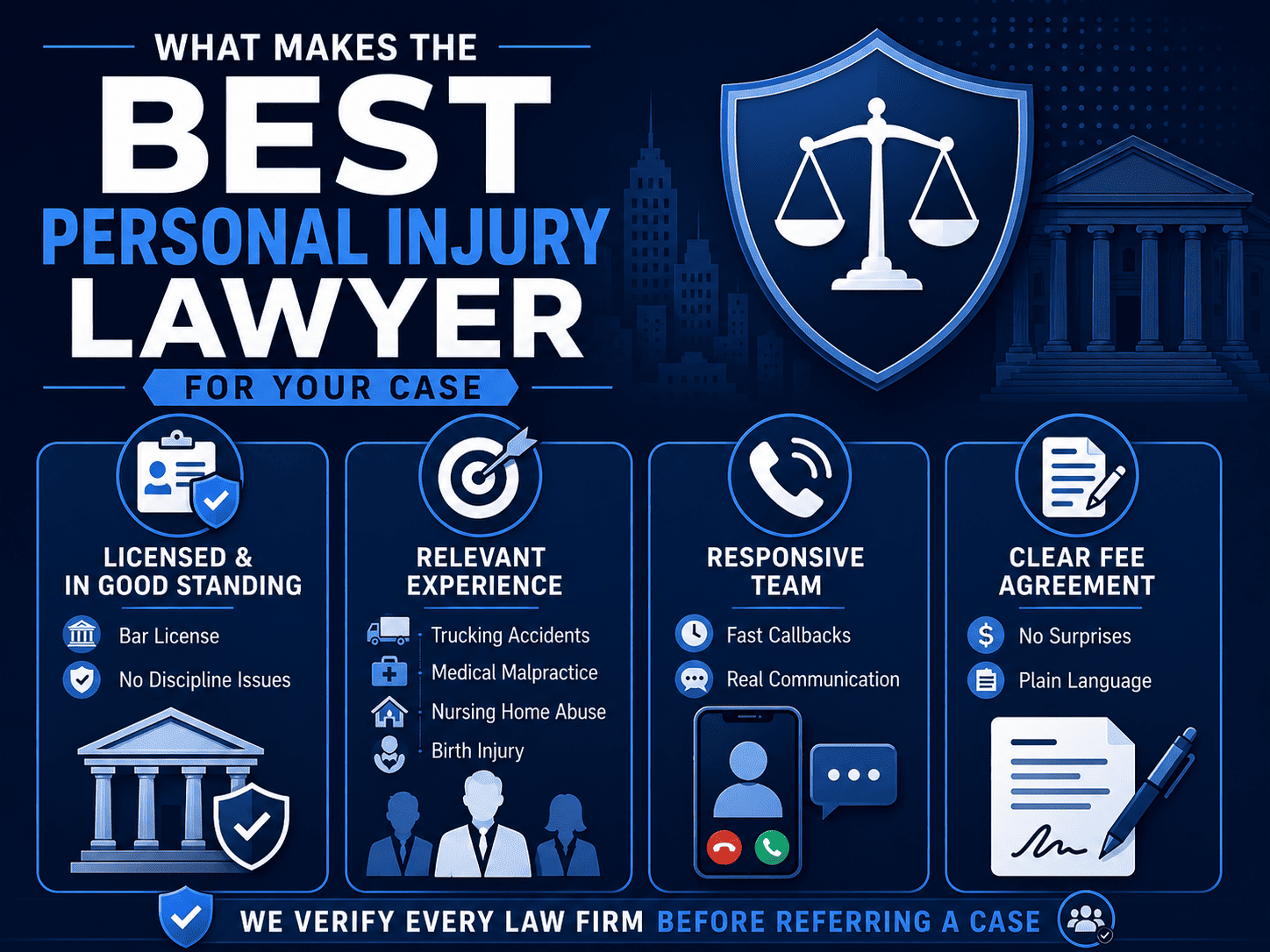
Active bar licence in every state they claim to serve, plus a public discipline search. An open suspension is disqualifying.
Personal injury is broad. A firm that tries trucking cases every month is not automatically the right choice for a birth injury or a nursing home claim. We match on what actually happened to you.
We track how long each firm takes to call a new claimant back. Firms that leave people waiting stop receiving cases.
Percentage, case costs, and what happens if you lose — in writing, before you sign.
Use these on any firm, including one we didn’t send you. They are the same four questions we ask, and the top rated personal injury attorneys answer all of them without hesitating. If a firm won’t put the fee terms in writing before you sign, that is your answer. Injury Case Claim is not a law firm and does not represent you — we connect you with the firms that do.
Nothing up front, and nothing at all if you don’t win.
Personal injury lawyers and injury attorneys almost always work on contingency: they take an agreed percentage of what they recover for you, typically in the region of a third, and if there is no recovery there is no attorney fee. You should never be asked for money up front by a personal injury law firm, and the free consultation is standard across the industry.
Our service is free to you at every stage. We are not a law firm — the personal injury lawyers in our network pay us when they take on a case we refer. That does not change the fee you agree with the firm, and it does not oblige you to hire anyone.

Every personal injury attorney we refer works on contingency.
Your details go only to the firm we introduce.
Injury lawyers admitted where you were actually hurt.