Whether a rideshare claim is worth thousands or a million usually comes down to one thing: what the app was doing at the moment of impact. Answer a few questions and a claim specialist will call you back — then match you with a rideshare accident attorney in your state. Free review, no fee unless you win.

Free and confidential. Submitting this does not create an attorney-client relationship.
A claim specialist will review your answers and call the number you gave us, then introduce you to a rideshare accident lawyer licensed in your state. If you have the trip in your app, screenshot the receipt before you speak to anyone — it is the fastest proof of what the driver was doing.
Call 800-589-3204This is an advertisement · Injury Case Claim is not a law firm
A rideshare accident lawyer handles injury claims arising from crashes involving Uber, Lyft and delivery platforms — whether you were the passenger, the rideshare driver, a pedestrian or cyclist, or in another vehicle entirely. The negligence test is ordinary. The insurance is not.
Rideshare cover is built in periods. App off: only the driver’s personal auto policy, and personal policies commonly exclude commercial use. App on, waiting for a request: the platform provides contingent liability at relatively modest limits. Ride accepted, through to drop-off: a commercial liability policy typically at $1 million, with uninsured and underinsured motorist cover alongside it in most states.
That means two crashes that look identical on the road can be worth wildly different amounts depending on what the driver had tapped thirty seconds earlier. Establishing the period — from trip records, timestamps and app data held by the platform rather than from the driver’s recollection — is the first and most valuable thing a rideshare attorney does.
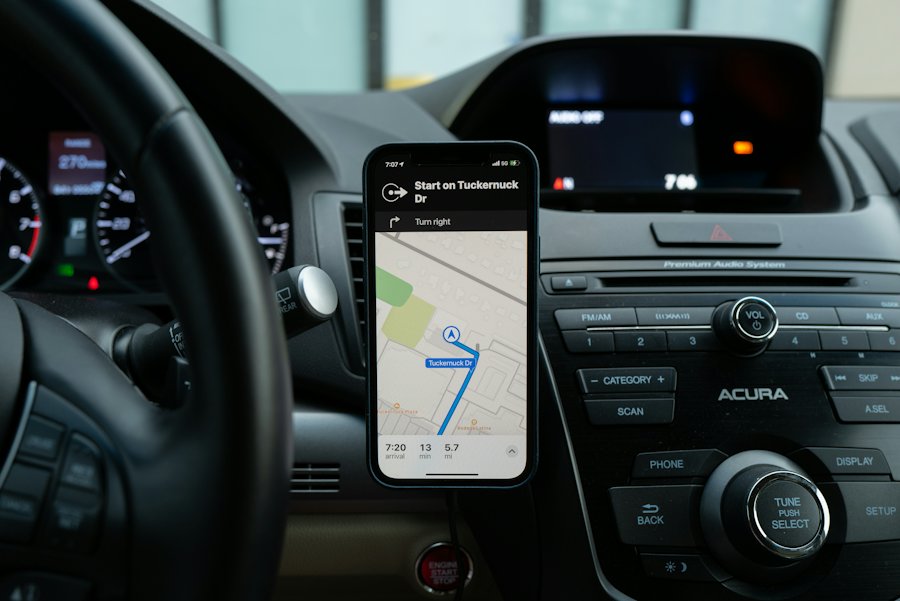
People search for this in a dozen ways and they all land in the same place. Uber accident lawyer, Lyft accident attorney, rideshare injury lawyer, Uber passenger injury attorney, Uber crash lawyer and gig driver accident attorney all describe the same work.
Where the words matter is your role in the crash. A passenger’s claim is usually the most straightforward. A rideshare driver injury lawyer may be dealing with occupational accident cover and a personal policy that excludes commercial use at the same time. A pedestrian struck by a driver mid-trip is claiming on a commercial policy they have never heard of. Say which you were on the form.
Note that rideshare assault claims — where a driver or passenger was assaulted rather than injured in a collision — are handled separately. See rideshare assault claims.
Your role in the crash decides which policy responds, how quickly, and how hard it is to get paid.
You are almost never at fault, so the only real question is which insurer pays — and that argument between insurers is where claims stall.
See If You Qualify 02You were in another vehicle. Whether the platform’s commercial policy applies depends on trip status you can’t see from the roadside.
See If You Qualify 03Injured while driving for a platform, with a personal policy that may exclude commercial use and occupational cover that may not.
See If You Qualify 04Hit by a driver on an accepted trip. The commercial policy often applies even though you had no connection to the ride at all.
See If You Qualify 05Delivery platform crashes, where cover frequently turns on whether a delivery had been accepted at the time.
See If You Qualify 06The at-fault driver has no cover or not enough. Rideshare UM/UIM policies frequently respond where a private policy would not.
See If You QualifyNot sure which one is yours? The categories overlap constantly — a delivery driver hit by an uninsured motorist is three of these at once. Pick whichever is closest and the specialist will sort it out on the call.
Start my free reviewBroadly, you have a claim worth taking to an attorney if most of these are true.
Uber, Lyft or a delivery platform — whether you were inside it, hit by it, or hit by someone else while riding in it.
The rideshare driver, the other driver, or occasionally the platform itself. As a passenger you do not need to work out which.
Including injuries that surfaced days later. Passengers in the back seat are frequently unrestrained against the front seats and pick up neck and shoulder injuries that present slowly.
Medical treatment, missed shifts, care you still need, and — if you drive for a platform — the earnings you lost while off the road.
Often two or three years, as little as one in some states. Check your deadline →
Two kinds of loss, and people routinely forget the second.
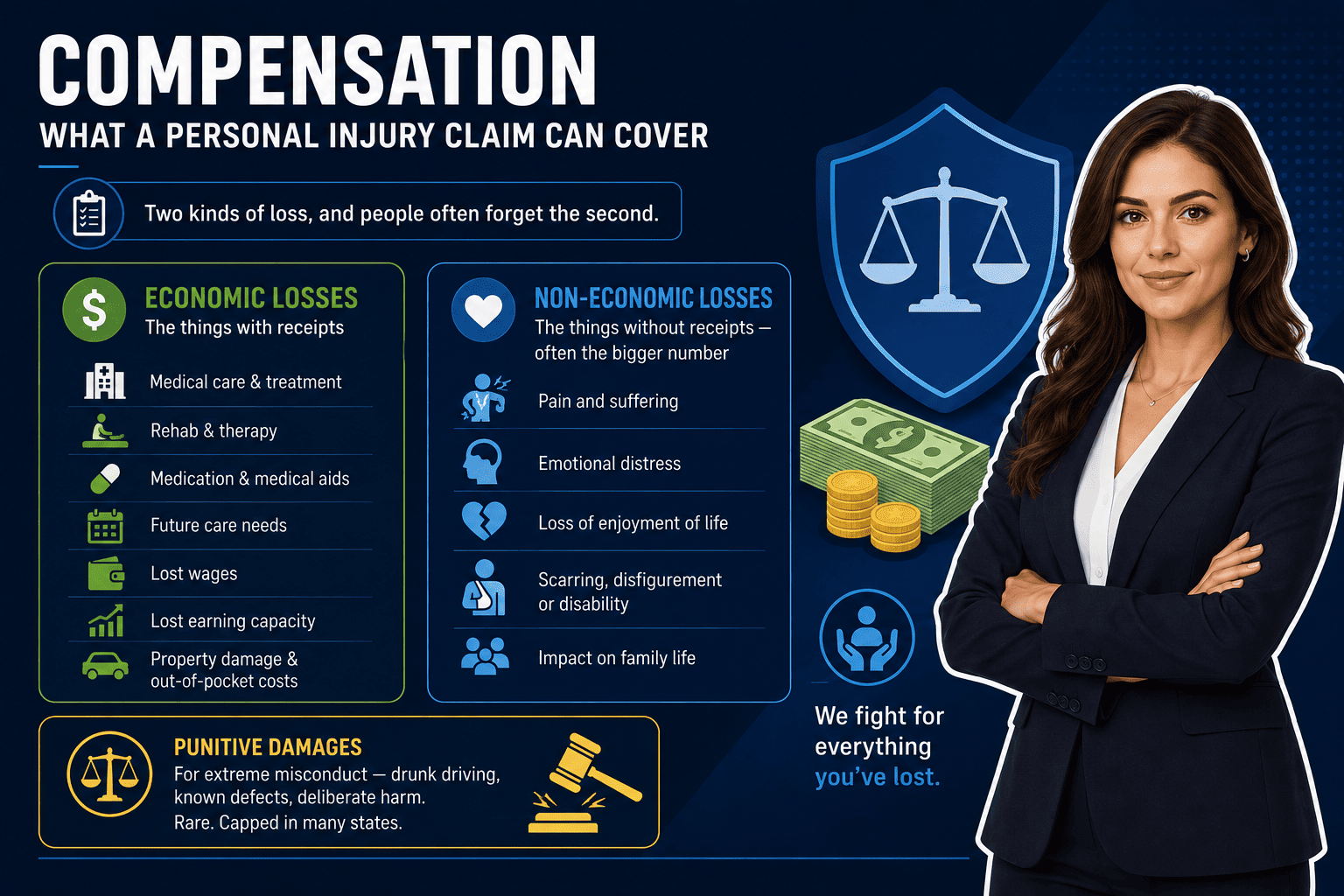
Punitive damages. Where the conduct was extreme — drunk driving, a known hazard ignored, deliberate harm — some states allow damages meant to punish rather than compensate. They are rare and capped in many places.

Period 0 — app off. The driver is a private motorist. Only their personal auto policy applies, and many personal policies contain an express exclusion for carrying passengers for hire, which can leave a coverage fight rather than a payout.
Period 1 — app on, no ride accepted. The platforms provide contingent liability cover, which sits behind the driver’s own policy and is typically limited — enough for property damage and modest injuries, rarely enough for a serious one.
Periods 2 and 3 — ride accepted, and passenger on board. A commercial liability policy applies, typically at $1 million, usually with uninsured and underinsured motorist cover alongside it in most states. This is the difference between a claim that is capped by a private driver’s limits and one that is not.
The practical point for you is that nobody at the scene can tell which period applied, the driver’s account is not evidence, and the records that settle it belong to the platform. Screenshot your own trip receipt if you were the passenger; if you were not, this is the first thing to get a lawyer onto.
If it happened recently, in this order. Steps two and three are specific to rideshare and people skip them.
Back-seat passengers are frequently unrestrained against the seat in front and pick up neck, shoulder and knee injuries that present a day or two later. A gap between the crash and your first medical visit is the main thing insurers use to argue you weren’t hurt.
The receipt, the driver’s name, the vehicle, the route and the timestamps. If you were the passenger this is the fastest proof of which insurance period applied, and app histories do not stay accessible forever.
The in-app report fixes the trip status on the platform’s own record. Keep it factual — report what happened, not how you feel about fault.
Including the trade dress in the windscreen, the plates of every vehicle involved, and the damage before anything is moved.
In a shared ride there may be other claimants who saw exactly what you saw. They leave within minutes.
You are allowed to say you will respond after speaking with a lawyer. A signed release ends the claim even if your injuries turn out worse than anyone thought.
Four rules decide what a rideshare claim is actually worth. Three are ordinary injury law; the fourth is specific to rideshare and is set state by state.
Most states cut your recovery by your percentage of blame. Some bar recovery entirely once you pass a set threshold, and a small number still apply the old contributory-negligence rule where any fault at all can end the claim.
Commonly two or three years from the injury, as little as one in some states, and only a few months’ formal notice where a government body is involved. Once it passes the claim is gone, however strong it was.
Most states have passed transportation network company statutes setting minimum cover for each period, and the minimums differ. Some states require uninsured motorist cover during accepted trips and some do not, which matters enormously when the at-fault driver has no insurance.
Some states cap non-economic damages, most often in claims against public bodies and in medical negligence. A cap can matter more to the outcome than anything about the injury itself.
These are general descriptions, not legal advice, and the rules change. Confirm anything that affects your claim with a lawyer licensed in the state where it happened — that is what the free review is for.
Searching for a “Uber accident lawyer near me” gets you whoever bought the biggest ad. What actually matters is that the attorney is licensed where you were hurt, because deadlines, fault rules and damage caps are all set state by state. Pick your state — or send the form and we’ll match you with a firm that handles your type of claim in your area.
Don’t see a page for your state yet? Selecting it takes you to the free case review with your state already filled in. We connect people with attorneys in all 50 states.
Every firm calls itself the best Uber and Lyft accident lawyer in town, which makes the phrase useless. Here is what we actually check before a firm receives anyone from us — and what you should check yourself, on any firm, including ones we never mentioned.
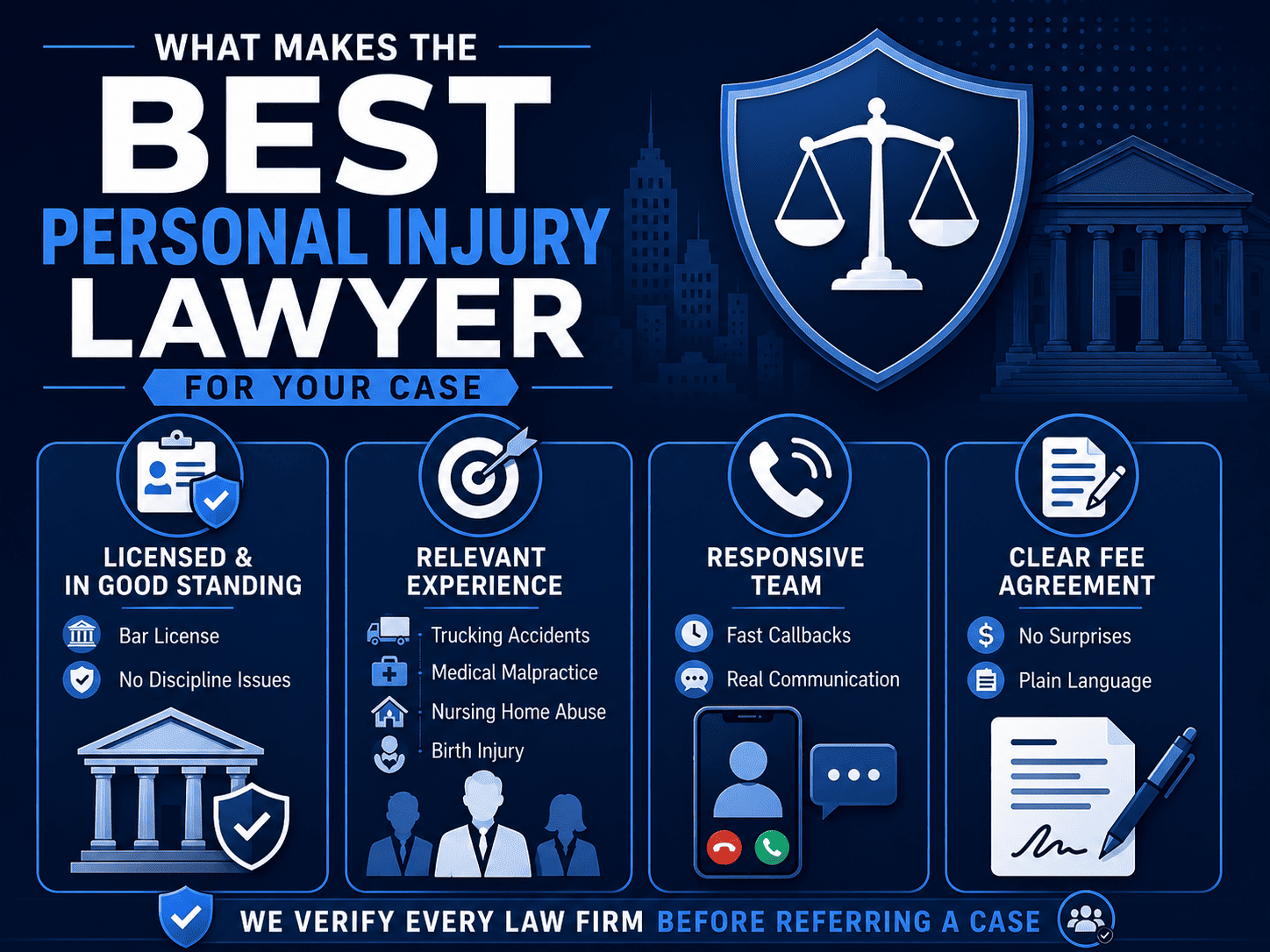
Active bar licence in every state they claim to serve, plus a public discipline search. An open suspension is disqualifying.
Ask how many rideshare claims the firm has resolved, whether they have obtained trip data from a platform before, and how they handle a coverage dispute where the personal insurer says commercial use and the platform says period 1.
We track how long each firm takes to call a new claimant back. Firms that leave people waiting stop receiving cases.
Percentage, case costs, and what happens if you lose — in writing, before you sign.
Use these on any firm, including one we didn’t send you. They are the same four questions we ask, and good firms answer all of them without hesitating. If a firm won’t put the fee terms in writing before you sign, that is your answer. Injury Case Claim is not a law firm and does not represent you — we connect you with the firms that do.
Nothing up front, and nothing at all if you don’t win.
Rideshare accident lawyers almost always work on contingency: they take an agreed percentage of what they recover for you, typically in the region of a third, and if there is no recovery there is no attorney fee. You should never be asked for money up front, and the free consultation is standard across the industry.
Our service is free to you at every stage. We are not a law firm — the lawyers in our network pay us when they take on a case we refer. That does not change the fee you agree with the firm, and it does not oblige you to hire anyone.
Every attorney we refer works on contingency.
Your details go only to the firm we introduce.
Lawyers admitted where you were actually hurt.