Riders get blamed before anyone has looked at the evidence, and insurers know it works. Answer a few questions and a claim specialist will call you back — then match you with a motorcycle accident attorney who actually rides these cases in your state. The review is free and there is no fee unless you win.

Free and confidential. Submitting this does not create an attorney-client relationship.
A claim specialist will review your answers and call the number you gave us, then introduce you to a motorcycle accident lawyer licensed in your state. If an insurer has already asked about your helmet, your gear or your speed, mention it on the call.
Call 800-589-3204This is an advertisement · Injury Case Claim is not a law firm
A motorcycle accident lawyer handles injury claims for riders and passengers hurt in crashes with cars, trucks, road hazards and defective motorcycle parts. The legal test is the same negligence test that applies to any road collision. What is different is everything around it.
Riders are hurt far more severely than drivers in comparable crashes, because there is no cage, no crumple zone and no airbag — the same impact that dents a bumper produces fractures, road rash, degloving injuries and brain and spinal trauma. That makes the medical side of a motorcycle claim bigger, longer and more expensive to prove.
At the same time, riders start with a presumption against them. Adjusters open motorcycle files looking at speed, licence endorsements, gear, exhaust modifications and whether you were filtering. A motorcycle attorney’s real work is often reconstruction — establishing sight lines, closing speeds and where each vehicle actually was — to replace an assumption about riders with evidence about this crash.
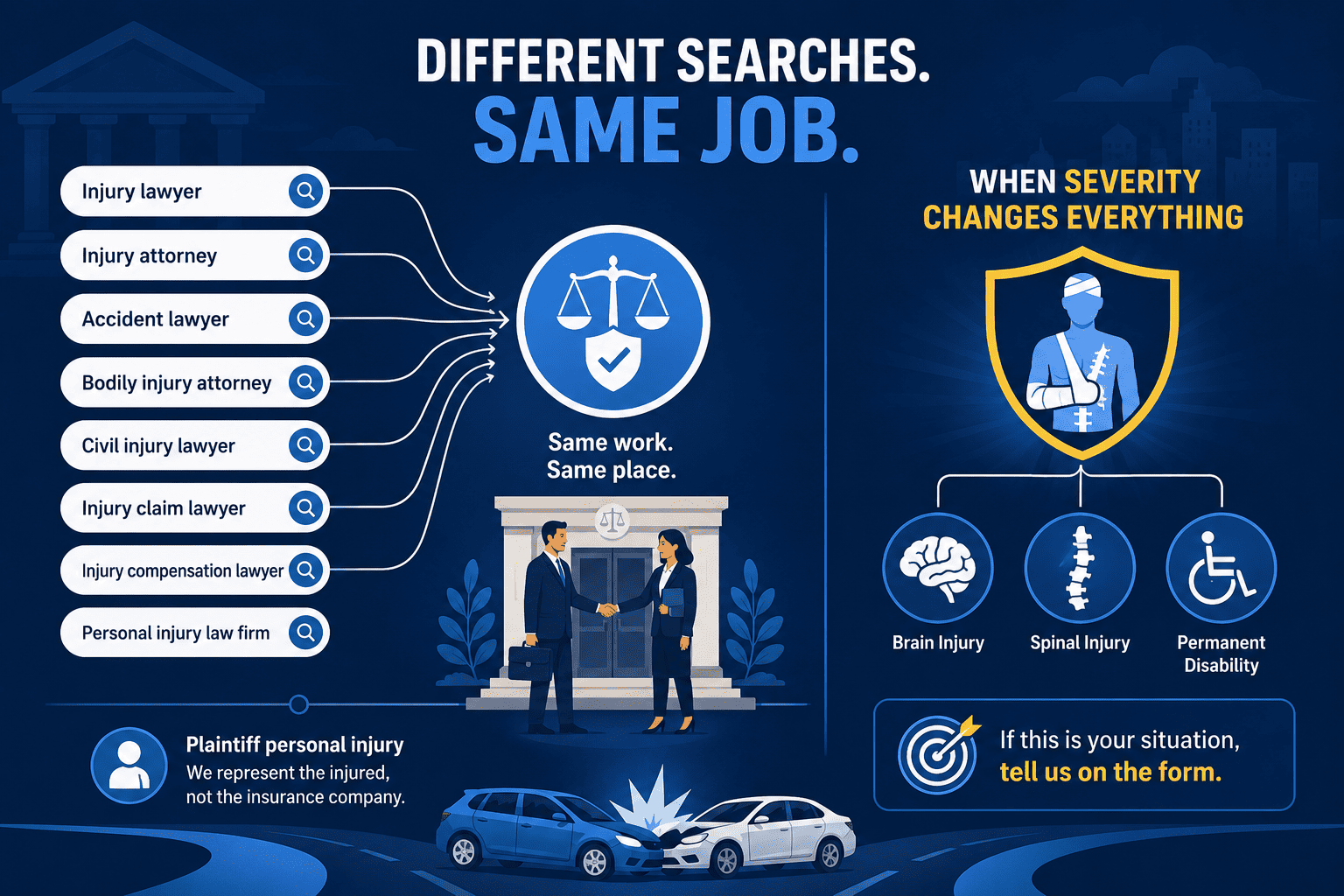
People search for this in a dozen ways and they all land in the same place. Motorcycle accident attorney, motorbike accident lawyer, biker lawyer, motorcycle injury attorney, motorcycle crash lawyer and motorcycle accident law firm all describe the same work.
Where the words matter is severity and cause. A catastrophic injury attorney handles claims involving brain and spinal injury or amputation, where lifetime care costs decide the number. A defective-part case — a failed brake, a tyre, a recalled component — is a product liability claim against a manufacturer, which is a different discipline again. Say what caused it on the form.
Most motorcycle crashes follow a small number of patterns, and almost all of them come down to a driver not registering that a motorcycle was there.
A driver turns across your path or pulls out of a junction. The most common and most serious motorcycle crash pattern there is.
See If You Qualify 02Drivers merging into a rider they never checked for, including sideswipes and crashes caused by sudden lane drift.
See If You Qualify 03Potholes, gravel, unmarked roadworks, sunken utility covers and debris — claims against road authorities and contractors, on short notice deadlines.
See If You Qualify 04Brake failure, tyre defects, steering and frame faults, and recalled components — product claims against a manufacturer rather than a driver.
See If You Qualify 05Collisions with trucks, vans and delivery fleets, where a commercial policy and a carrier’s records come into play.
See If You Qualify 06Brain and spinal injury, amputation, severe road rash and burns, and claims brought by a family after a rider’s death.
See If You QualifyNot sure which one is yours? Plenty of motorcycle claims sit in more than one category — a crash caused by gravel left by a contractor is a road hazard case and a negligence case against the driver behind you. Pick whichever is closest and the specialist will sort it out on the call.
Start my free reviewBroadly, you have a claim worth taking to a motorcycle accident attorney if most of these are true.
A driver who turned across you, merged into you or pulled out of a junction; a road authority that left a hazard unmarked; a manufacturer whose part failed. You do not need to prove which at this stage.
Including injuries that surfaced later. Head and spinal injuries are routinely missed at the roadside, and road rash that looks superficial can need grafting.
This is where reconstruction matters most in motorcycle cases, because the other driver’s account is usually the only one anyone wrote down at the scene.
Medical treatment, missed work, the bike and your gear, care you still need, and the things you can no longer do.
Often two or three years, as little as one in some states, and a matter of months where a road authority is involved. Check your deadline →
Two kinds of loss, and on rider injuries the second is frequently the larger one.
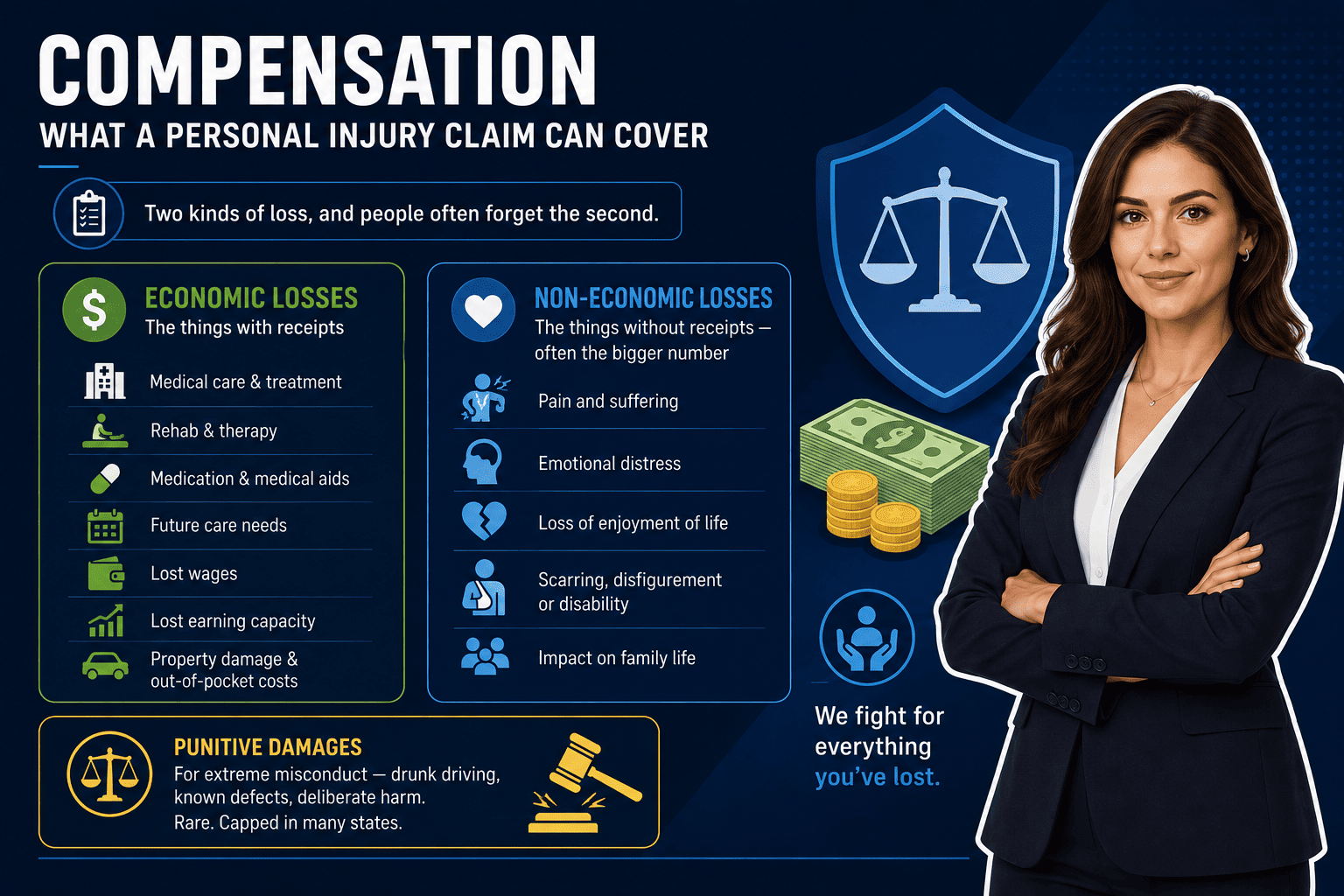
Punitive damages. Where the conduct was extreme — drunk driving, a known hazard ignored, deliberate harm — some states allow damages meant to punish rather than compensate. They are rare and capped in many places.
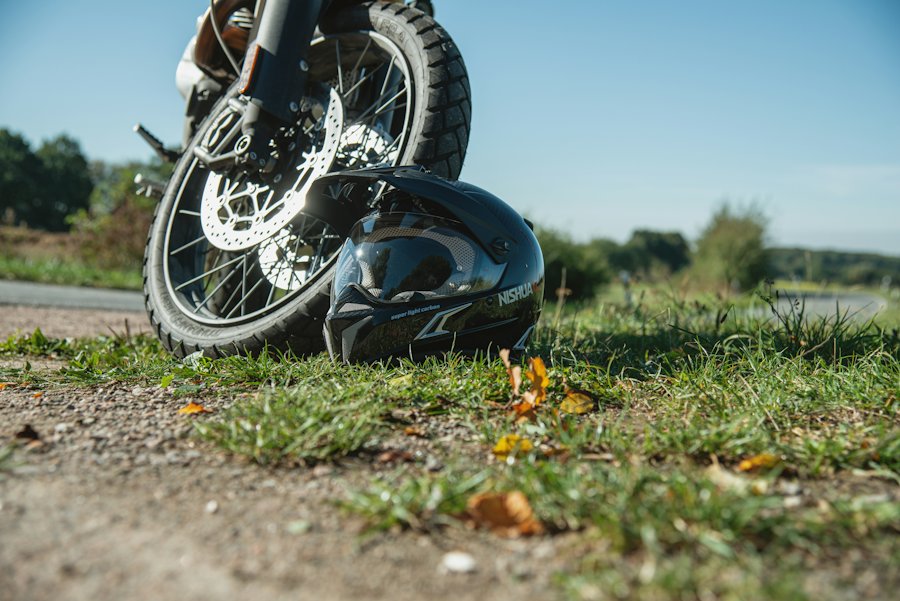
Ask an adjuster about a motorcycle file and the questions arrive in a predictable order: how fast was he going, was he wearing a helmet, what was on the bike, did he have the endorsement. Ask about a car file and the first question is usually who had right of way. That difference is the single biggest practical obstacle in a rider’s claim, and it exists before anyone has looked at the road.
It is answered with evidence rather than argument. Sight-line analysis showing what the driver could have seen and when. Closing speeds calculated from the damage rather than estimated by a witness. Scene photographs showing the point of impact and the rest position of both vehicles. Helmet and gear documented, because a rider in full gear is a different story to a jury than one described in the abstract.
The practical consequence for you is simple: do not argue with an adjuster about whether riders are reckless, and do not concede anything about your speed, your gear or your filing position in a recorded statement. Those are the pieces the case gets built on, and they are worth more once a lawyer has them.
If it happened recently, in this order. Step five is the point at which most riders start looking for an attorney.
Adrenaline hides injuries for a day or two, and helmet impacts produce concussion that does not show at the roadside. A gap between the crash and your first medical visit is the single most common thing insurers use to argue you weren’t really hurt.
The road surface, debris, skid marks, the point of impact, the damage to the bike, your helmet, and your jacket and gloves. Gear that did its job is evidence — do not throw it away or let anyone else keep it.
Motorcycle crashes are frequently written up from the driver’s account because the rider has been taken to hospital. If that happened to you, say so — the report can be supplemented.
People leave within minutes and are almost impossible to trace afterwards. In a left-turn collision an independent witness is often the whole case.
You are allowed to say you will respond after speaking with a lawyer. These three subjects are where motorcycle claims are won and lost, and the questions are not idle.
Do not authorise repairs or let the insurer dispose of the motorcycle until it has been inspected. On a defective-part claim the bike is the evidence.

Four rules decide what a rider’s claim is actually worth, and all of them are set state by state. This is why the attorney has to be licensed where it happened.
Most states cut your recovery by your percentage of blame. Some bar recovery entirely once you pass a set threshold, and a small number still apply the old contributory-negligence rule where any fault at all can end the claim.
Commonly two or three years from the injury, as little as one in some states, and only a few months’ formal notice where a government body is involved. Once it passes the claim is gone, however strong it was.
Helmet requirements differ by state and by rider age, and lane splitting is permitted in a small number of states, prohibited in some and unaddressed in others. Where a state allows helmet non-use to reduce damages, it usually reduces the head-injury portion rather than barring the claim.
Some states cap non-economic damages, most often in claims against public bodies and in medical negligence. A cap can matter more to the outcome than anything about the injury itself.
These are general descriptions, not legal advice, and the rules change. Confirm anything that affects your claim with a lawyer licensed in the state where it happened — that is what the free review is for.
Searching for a “motorcycle accident lawyer near me” gets you whoever bought the biggest ad. What actually matters is that the attorney is licensed where you were hurt, because deadlines, fault rules and damage caps are all set state by state. Pick your state — or send the form and we’ll match you with a firm that handles your type of claim in your area.
Don’t see a page for your state yet? Selecting it takes you to the free case review with your state already filled in. We connect riders with motorcycle accident attorneys in all 50 states.
Every firm calls itself the best motorcycle accident lawyer in town, which makes the phrase useless. Here is what we actually check before a firm receives anyone from us — and what you should check yourself, on any firm, including ones we never mentioned.
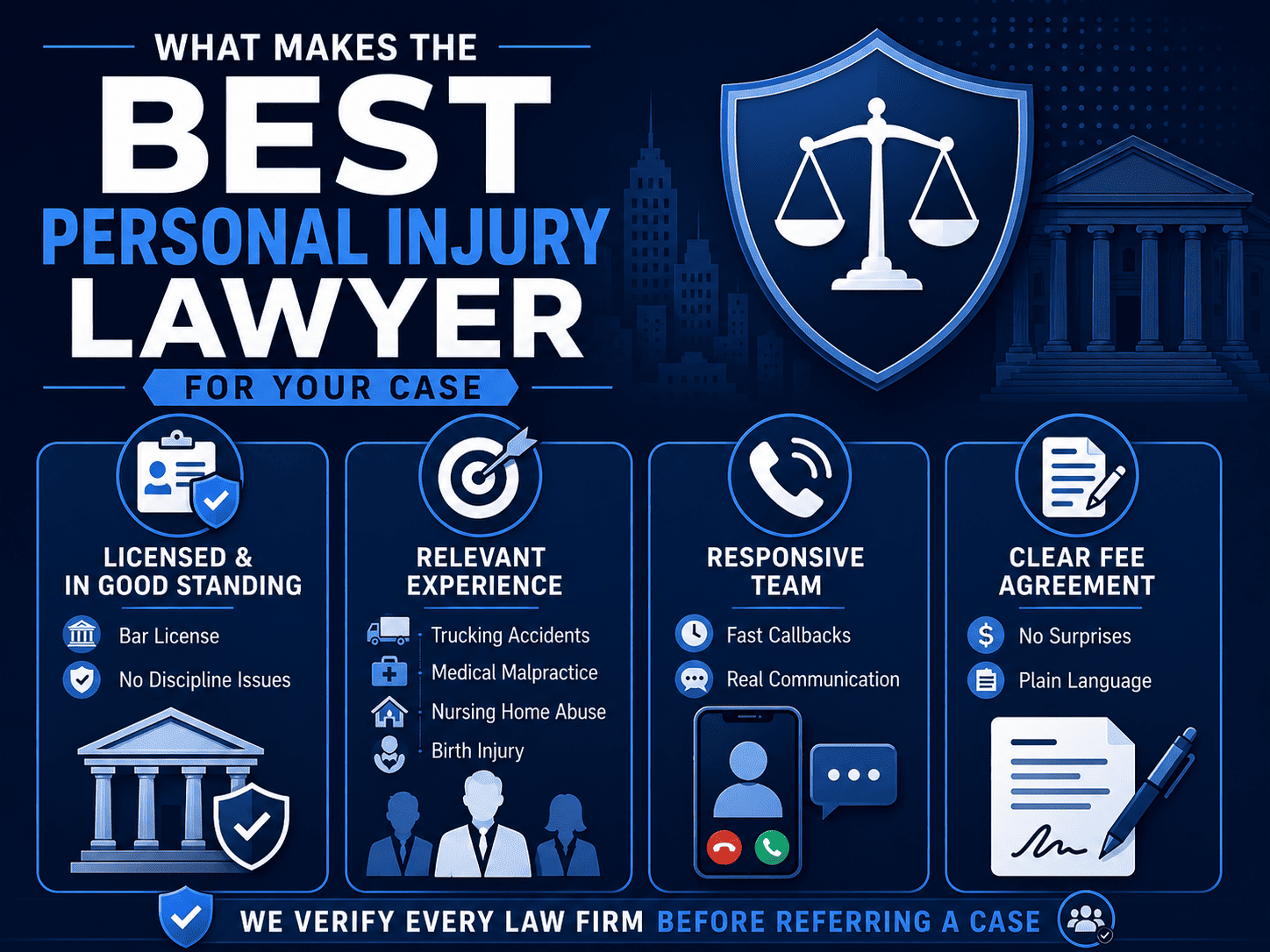
Active bar licence in every state they claim to serve, plus a public discipline search. An open suspension is disqualifying.
Motorcycle claims are not car claims with a different vehicle. Ask how many rider cases the firm has resolved, whether they use accident reconstruction as a matter of course, and how they handle helmet and lane-splitting arguments.
We track how long each firm takes to call a new claimant back. Firms that leave people waiting stop receiving cases.
Percentage, case costs, and what happens if you lose — in writing, before you sign.
Use these on any firm, including one we didn’t send you. They are the same four questions we ask, and good firms answer all of them without hesitating. If a firm won’t put the fee terms in writing before you sign, that is your answer. Injury Case Claim is not a law firm and does not represent you — we connect you with the firms that do.
Nothing up front, and nothing at all if you don’t win.
Motorcycle accident lawyers almost always work on contingency: they take an agreed percentage of what they recover for you, typically in the region of a third, and if there is no recovery there is no attorney fee. You should never be asked for money up front, and the free consultation is standard across the industry.
Motorcycle cases carry higher case costs than ordinary car claims, because reconstruction and medical expert evidence are needed far more often. The firm advances those costs — what differs is whether they come back to you if the case fails.
Our service is free to you at every stage. We are not a law firm — the lawyers in our network pay us when they take on a case we refer. That does not change the fee you agree with the firm, and it does not oblige you to hire anyone.

Every attorney we refer works on contingency.
Your details go only to the firm we introduce.
Lawyers admitted where you were actually hurt.