We are sorry for your loss. If someone else’s carelessness caused a death in your family, the law allows a claim for what that has cost you — and there is no obligation in finding out whether you have one. Answer a few questions and a claim specialist will call you back, then match you with a wrongful death attorney licensed in your state.

Free and confidential. Submitting this does not create an attorney-client relationship.
A claim specialist will review your answers and call the number you gave us, then introduce you to a wrongful death lawyer licensed in your state. Take the call whenever you are ready — if the timing is wrong, say so and they will arrange another.
Call 800-589-3204This is an advertisement · Injury Case Claim is not a law firm
A wrongful death claim is a civil claim brought when someone dies because another person or organisation failed to take reasonable care. It is not a criminal prosecution and it does not depend on one — the standard of proof is lower, which is why families succeed in civil claims arising from incidents that were never charged.
Most states allow two related claims. The wrongful death claim compensates the family for what the death cost them: the financial support the person would have provided, the things they did for the household, and the loss of their care, guidance and companionship. A survival action belongs to the estate and covers what the person themselves went through before they died, including their pain and their medical bills. Where both are available, bringing them together matters a great deal to the outcome.
Who may file is set by statute and differs between states — sometimes only the personal representative of the estate, sometimes named family members in their own right, with unmarried partners and stepchildren treated inconsistently across the country. Working out who has standing, and in what order, is among the first things a wrongful death attorney does.
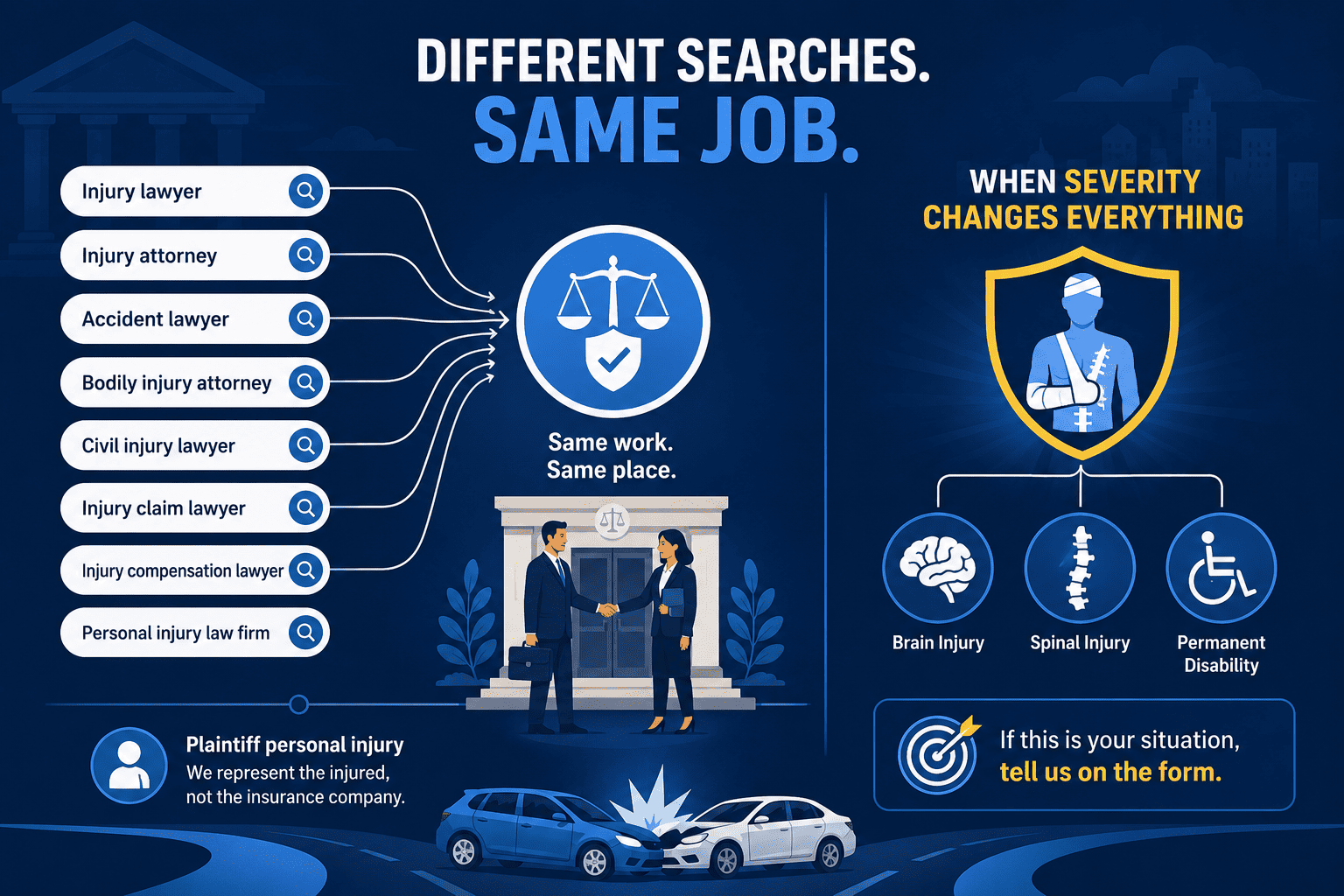
People search for this in several ways and they all land in the same place. Wrongful death attorney, fatal accident lawyer, fatal injury attorney, wrongful death law firm and survival action lawyer all describe the same work.
Where the words matter is the cause of the death, because the discipline differs entirely. A fatal crash is a motor vehicle claim; a death on a site is a workplace and third-party claim; a death in a hospital or care home is a medical negligence claim with its own expert requirements and, in many states, its own shorter deadlines and damage caps. Say what happened on the form and you will be matched accordingly.
The law does not distinguish between causes — what it asks is whether someone owed a duty of care and failed in it. In practice the evidence differs enormously by cause, which is why the right firm matters.
Car, motorcycle, pedestrian and cyclist deaths, including hit-and-run and impaired driving.
See If You Qualify 02Fatal crashes involving carriers, where federal safety records and the carrier’s own data are central and are on a retention clock.
See If You Qualify 03Site deaths where workers’ compensation is only part of the picture and a third-party claim may exist alongside it.
See If You Qualify 04Deaths caused by misdiagnosis, surgical error, medication mistakes, or neglect in a nursing or residential facility.
See If You Qualify 05Deaths caused by a product that failed or was sold without adequate warning, including dangerous drugs and medical devices.
See If You Qualify 06Deaths on unsafe property, including fires, falls from height, pool and water incidents, and assaults enabled by inadequate security.
See If You QualifyNot sure which one applies? Many of these overlap — a site death caused by faulty equipment is a workplace claim and a product claim. Pick whichever is closest and the specialist will sort it out on the call.
Start my free reviewBroadly, there is a claim worth taking to a wrongful death attorney if most of these are true.
A driver, an employer, a property owner, a doctor or hospital, a care facility, a manufacturer. It does not require anyone to have intended harm, and it does not require a criminal charge.
Including where an existing illness or injury was made fatal by the failure. Causation is usually the most contested element in medical cases in particular.
Usually the personal representative of the estate, or named family members. If you are unsure whether that includes you, that is a question worth asking rather than assuming.
Funeral and burial costs, medical care before death, lost financial support and benefits, the value of what they did for the household, and the loss of their companionship and guidance.
Commonly two or three years from the death, shorter in some states, and sometimes only months where a public body or public hospital is involved. Check your deadline →
Two kinds of loss, and in these claims the second is usually the harder one to quantify and the more significant.
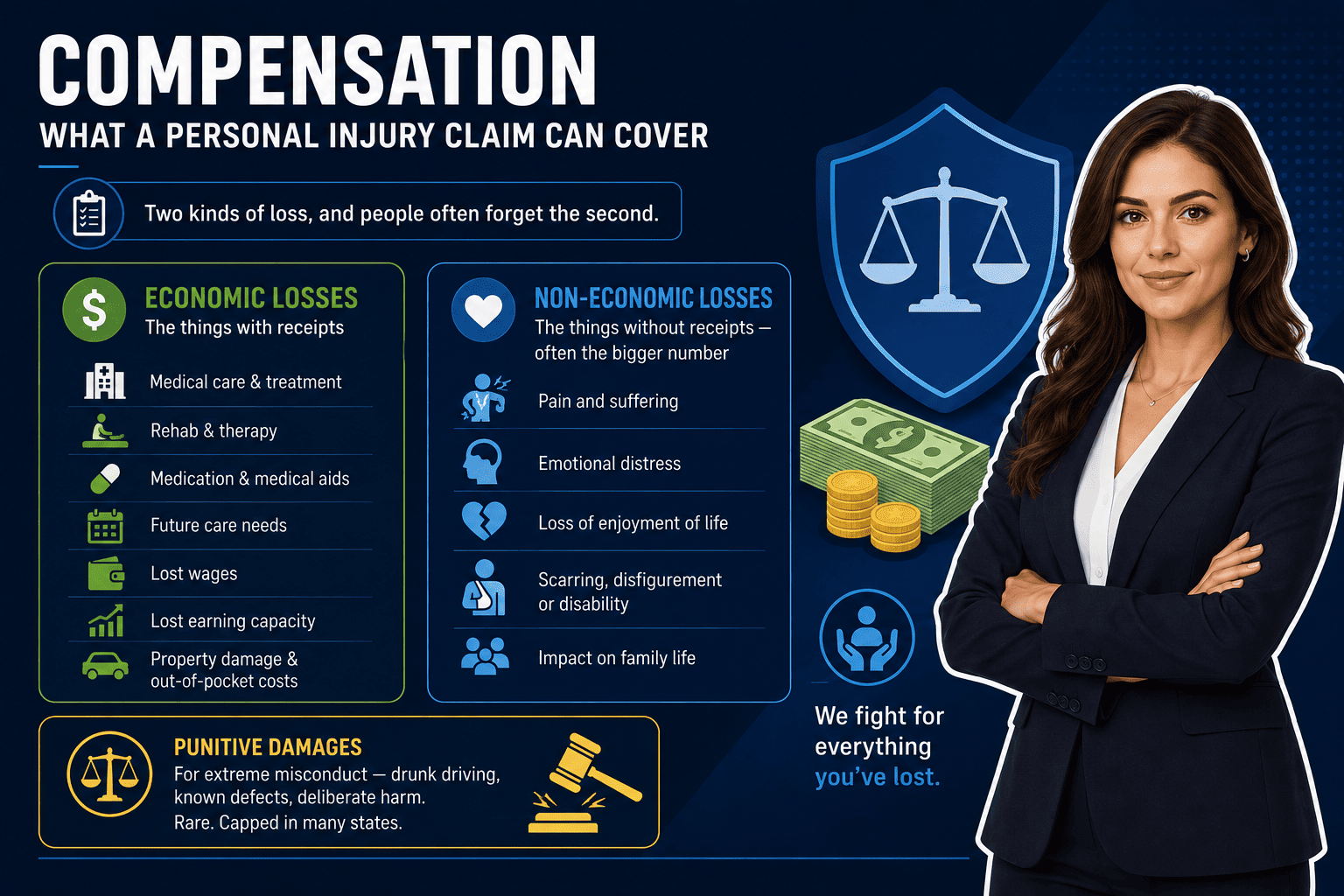
Punitive damages. Where the conduct was extreme — drunk driving, a known defect sold anyway, a hazard concealed — some states allow damages intended to punish rather than compensate. Availability, and whether they pass to the family or the estate, differ by state.

Most families have no idea what they are agreeing to when they call a lawyer, and the uncertainty is part of what stops people. In outline, it goes like this.
A free conversation. You describe what happened. The lawyer tells you whether there appears to be a claim, who in the family would need to bring it, and what the deadline is in your state. Nothing is signed and nothing is owed. A great many of these conversations end with “there isn’t a claim here”, and that answer costs nothing either.
Opening an estate, where it is needed. In states where only a personal representative can file, someone has to be appointed. Firms handle this routinely and it is usually less onerous than it sounds.
Investigation. Records, evidence, experts. In fatal crashes that can mean reconstruction and a carrier’s data; in medical cases it means independent expert review, which is required before filing in many states. This is the longest phase and it is where the claim is actually built.
A claim, then usually a settlement. The overwhelming majority of wrongful death claims resolve without a trial. Where a case is filed, the family is prepared carefully and shielded from as much of it as possible. If testifying is something you are worried about, say so early — it is a normal thing to ask about and it can shape how the case is run.
There is no rush on most of this, and nobody expects a grieving family to be gathering paperwork. These are simply the things that help later, in roughly the order they tend to matter.
Nothing below is more urgent than that. Filing deadlines are measured in years in most states, and a lawyer can tell you yours in a five-minute call whenever you are ready.
Death certificate, medical records and bills, the police or coroner’s report, funeral invoices, and anything an employer or insurer sends. You do not need to organise it — just keep it together.
Releases, authorisations and settlement offers all arrive early and all have consequences. It is entirely reasonable to say you will respond once you have spoken to a lawyer.
Names and phone numbers. Colleagues, witnesses, other residents, other patients’ families. Memories and contact details both fade fast.
Knowing whether you have three years or three months changes how much room you have to think. The answer is free.
In many states only a personal representative can bring the claim. Firms deal with this as a matter of routine, but it takes time, so it is worth knowing sooner.
Four rules decide what a wrongful death claim is worth and who may bring it. All of them are statutory, and they differ more between states than in any other area of injury law.
Most states cut your recovery by your percentage of blame. Some bar recovery entirely once you pass a set threshold, and a small number still apply the old contributory-negligence rule where any fault at all can end the claim.
Commonly two or three years from the injury, as little as one in some states, and only a few months’ formal notice where a government body is involved. Once it passes the claim is gone, however strong it was.
Wrongful death is entirely statutory, so both the list of people entitled to bring a claim and the list of recoverable losses are set by each state. Some states allow the family’s grief and mental anguish; others exclude it expressly. Some cap non-economic damages, particularly in medical cases.
Some states cap non-economic damages, most often in claims against public bodies and in medical negligence. A cap can matter more to the outcome than anything about the injury itself.
These are general descriptions, not legal advice, and the rules change. Confirm anything that affects your claim with a lawyer licensed in the state where it happened — that is what the free review is for.
Searching for a “wrongful death lawyer near me” gets you whoever bought the biggest ad. What actually matters is that the attorney is licensed where you were hurt, because deadlines, fault rules and damage caps are all set state by state. Pick your state — or send the form and we’ll match you with a firm that handles your type of claim in your area.
Don’t see a page for your state yet? Selecting it takes you to the free case review with your state already filled in. We connect people with attorneys in all 50 states.
Every firm calls itself the best wrongful death lawyer in town, which makes the phrase useless. Here is what we actually check before a firm receives anyone from us — and what you should check yourself, on any firm, including ones we never mentioned.
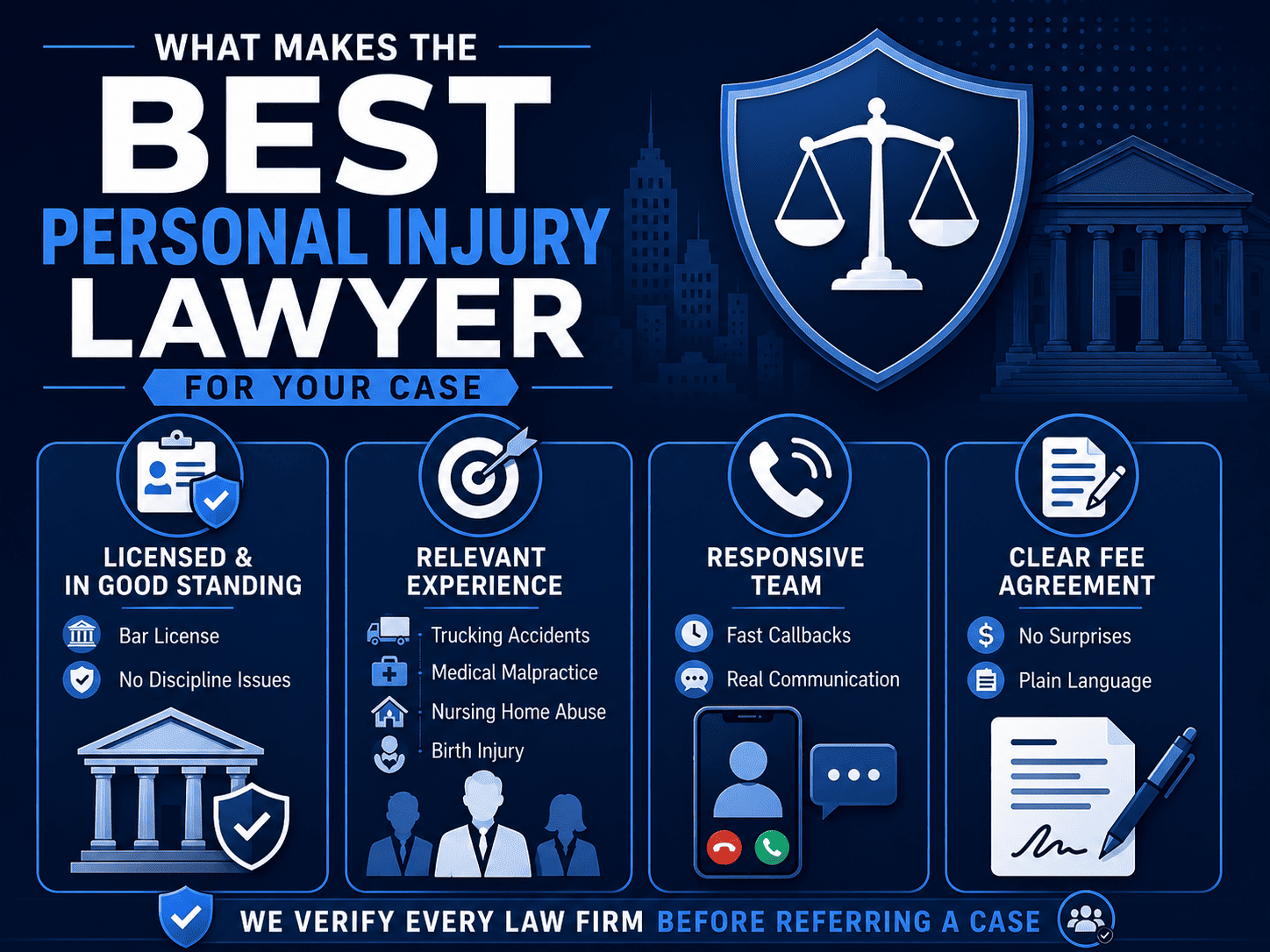
Active bar licence in every state they claim to serve, plus a public discipline search. An open suspension is disqualifying.
Wrongful death is statutory and the cause dictates the discipline. Ask how many fatal claims of your particular kind the firm has resolved, whether they handle opening an estate, and who in the firm will be the family’s point of contact day to day.
We track how long each firm takes to call a new claimant back. Firms that leave people waiting stop receiving cases.
Percentage, case costs, and what happens if you lose — in writing, before you sign.
Use these on any firm, including one we didn’t send you. They are the same four questions we ask, and good firms answer all of them without hesitating. If a firm won’t put the fee terms in writing before you sign, that is your answer. Injury Case Claim is not a law firm and does not represent you — we connect you with the firms that do.
Nothing up front, and nothing at all if you don’t win.
Wrongful death lawyers almost always work on contingency: they take an agreed percentage of what they recover for you, typically in the region of a third, and if there is no recovery there is no attorney fee. You should never be asked for money up front, and the free consultation is standard across the industry.
Fatal claims are expensive to build — economists, medical experts, reconstruction — and the firm advances those costs. Where the claim is brought by an estate, a court may also review the fee before approving a settlement.
Our service is free to you at every stage. We are not a law firm — the lawyers in our network pay us when they take on a case we refer. That does not change the fee you agree with the firm, and it does not oblige you to hire anyone.

Every wrongful death attorney we refer works on contingency.
Your details go only to the firm we introduce.
Ask what your options are. Deciding nothing is a valid outcome.